


2025 Mummers Festival
November 29 to December 13
Mummers Parade
Saturday December 13
About Us
The Mummers Festival is a participant-focused, community-based festival that encourages the celebration of mummering traditions. Each year, the Mummers Festival hosts events over the last week of November, and the first two weeks of December leading up to its crowning event, the Mummers Parade. Workshops, public forums with mummer experts, lectures and school programming act as educational and momentum-building events for the big Parade Day. Participants can build a jaw-snapping hobby horse or learn how to play their own homemade ugly stick. Audiences meet mummer experts (those long-term, experienced locals who have been mummering for decades) and receive first-hand knowledge about the many intricacies of this tradition.
"Where foolish is the new normal, underwear
is outerwear, and a curtain is more than just a curtain."
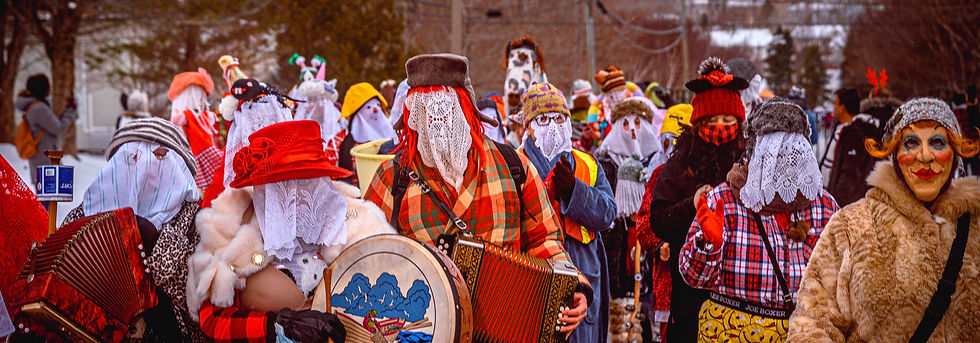
The Mummer Parade draws out families and friends of various backgrounds and ages who dress in mummer disguises and parade through the streets. For this one day, everyone is a mummer with the freedom to act out in fun and surprising ways. The Mummers Festival successfully taps into one of the most important elements of the mummering tradition: social bonding. Like many other Christmas traditions, mummering brings together families, friends and strangers alike to create a sense of community. The Mummers Festival and Parade is the biggest celebration of this 300 year old tradition. It is the newly veiled face of mummering working to keep cultural identity alive and strong.
learn more about the history of the mummers festival
Ryan Davis was the founding Executive Director of the Mummers Festival back in 2009, when it was envisioned as a folklore project. Check out our video with Ryan and learn about how we've grown over 15 years!
Our History
The Mummers Festival was initially a joint initiative with the Intangible Cultural Heritage division of the Heritage Foundation of Newfoundland and Labrador and Memorial University’s Folklore Department. The initiative began in 2009 with the intention of passing along a well-researched model to a community group who would continue organizing the Mummers Festival. That year, the Festival included 16 free community events throughout the month of December. In 2010 a Mummers Festival community group was established and run entirely by volunteers. In 2011, the Mummers Festival incorporated as a nonprofit entity. The Festival celebrated its 15th anniversary in 2023.
Our Mandate
To produce festivals for the purpose of education, charity, cultural promotion, community engagement and advancement of the public’s understanding and appreciation of Newfoundland and Labrador folk traditions related to mummering and Christmastime practices; and to assist in the transmission of these folk traditions through participation by the public and tradition-bearers in such festivals and related forums, lectures, workshops, performances and public events.
Our Goal
The Mummers Festival aims to promote the continuance and evolution of traditional arts and performance by encouraging active participation in mummering activities. All events are designed to equip the public with skills and knowledge about mummering so that they can better participate in our Parade day events and, it is hoped, the house-visiting traditions that occur during the twelve days of Christmas.
Conserving culture
The Mummers Festival was guided by principles of cultural conservation and intangible cultural heritage and influenced by folklife festival models, known for their ethnographic approach to planning. The goal is to see traditions live. Each year, the Festival creates new opportunities to pass along traditional skills and knowledge. A folklife festival model attempts to achieve the goals of cultural understanding and cultural transmission as encouraged by UNESCO’s policies on intangible cultural heritage. At the heart of the Mummers Festival is the aspiration to represent, celebrate, and inspire the transmission of collective cultural knowledge in a grassroots way.

Mummers Parades
in newfoundland
Since the Mummers Festival's beginning in 2009, 12 other communities in the province of Newfoundland & Labrador have started their own mummers parades or walks. For a tradition that is supposedly “dying out”, mummer-themed community events help reinvigorate mummering and ensure that youth are exposed to the finer details and actions of the tradition. Our Festival inspires other communities to take ownership of their own traditions and make them relevant for the next generation.

What is Intangible
Cultural Heritage?
Intangible Cultural Heritage (ICH) describes, among other things, our stories, holidays, community gatherings, culinary arts, rituals, songs and languages. We have long thought of heritage as tangible things (like our buildings, our furniture, our clothing) that have been handed down to us, and that we can preserve in our homes, museums and historic sites. However, many communities and peoples around the world recognize that this is only a part of what makes up their heritage, and that intangible ideas, customs and knowledge are equally important for cultural identity.
Generated in-and held collectively by-members of a community, such knowledge is dynamic. It is transmitted across generations and shaped anew as each generation innovates, experiments and adapts to changing social norms and values. Specifc ICH processes and practices include oral traditions, customs, drama, languages, music, dance, celebrations, and special skills needed to create and use tools and crafts that emerge from the local habitat and economy. Mummering is a type of traditional drama and considered to be a form of intangible cultural heritage.
What is a Folklife Festival?
Described as an exposition of intangible cultural heritage, a folklife festival is just one way to help encourage the celebration of traditions and recognize tradition-bearers. A folklife festival strives to provide the opportunity for people of varying backgrounds to come together and explore the many aspects of particular traditions. A folklife festival attempts to achieve the goals of cultural understanding and cultural transmission, as encouraged by UNESCO’s policies on intangible cultural heritage (ICH).
Since 1967 the Smithsonian Institution’s Center for Folklife and Cultural Heritage in Washington has been producing an annual folklife festival and has served as a model of a research-based exposition of intangible cultural heritage. They describe their folklife festival as “an exercise in cultural democracy, in which cultural practitioners speak for themselves, with each other, and to the public.” The Mummers Festival is an attempt to model the Smithsonian’s methodology and approach but with due attention to the differences in context.
At the heart of a folklife festival is the aspiration to represent collective cultural knowledge. This approach encourages the free and informed participation of community members and tradition-bearers who, it is hoped, will play a central role in the shape of a festival’s development and overall outcome.
A folklife festival aims to ensure traditions are renewed and kept alive. Preserving and safeguarding culture does not suggest the protection of traditions from outside forces, but rather, supports the conditions necessary for cultural reproduction. In line with cultural conservation, ICH policies encourage the sustainability of traditions by taking a natural-heritage-as-living-systems approach that seeks to sustain the whole system as a living, dynamic entity.

creating
community
The Mummers Festival acts as a deeply meaningful event that celebrates the spirit of coming together with friends, family and strangers alike. In an urban setting like St. John’s with a diverse public, the Festival provides a welcoming introduction to local Christmastime customs for newcomers and visitors. Our free events make sure everyone can join in.
The Mummers Festival taps into the spirit of Christmas that people long for in the face of a highly commercial time of year and conjures a sense of unique place. It is a staging ground for the expression of Newfoundland pride. Our events produce unforgettable memories and induce someimpressive natural highs.


2009
Janney Film Night
Mummering Memories
Pocket Mummer Workshop
Mummering Today: a lecture
Hobby Horse and Wren Stick Workshop
Hark What’s the Noise: a display of mummer craft
“How do you mummer anyway?”: a public forum A Mummers Play Making Mummers Masks
The Philadelphia Mummers Parade: a lecture
Framing Festivals
Mini Mummers School Visits
Rig Up
Mummers Parade
Mummers Concert and Mummers Jam
2010
Hobby Horse Workshops
Mummering Past and Present: 3 lectures
Mummers and Masks: a mummers film
Rig Up
Mummers Parade
Mummers Concert and Jam
2011
Hobby Horse Workshops
Mini Mummers School Tour
“How do you mummer anyway?”: a public forum
Ugly Stick Workshops
Visions and Visitors: Media Images of Christmas Mumming in Newfoundland Mummers and Masks: a film
Rig Up
Mummers Parade
Mummers Concert & Jam
2012
Hobby Horse Workshops
Mummers and Murder: Reinvestigating the Death of Isaac Mercer
Ugly Stick Workshops
Mini Mummers School Tour
“How do you mummer anyway?”: a public forum
Mummer Movies: CBC’s Land & Sea Mummers
Rig Up
Mummers Parade
Mummers Parade Concert and
Mummers Jam
Mummer-oke
2013
Hobby Horse Workshops
Box and Bird Mask Workshop
Ugly Stick Workshops
Mini Mummers School Tour
Newfoundland Mummers Play and Pocket Mummers
A Night of Mummering with Northern Ireland’s Armagh Rhymers
Mumming in Northern Ireland: a doc and talk with the Armagh Rhymers
Armagh Rhymers at the Inn of Olde: a night of performance, music, and recitation
Rig Up
Mummers Parade
Mummers Scuff ‘n’ Scoff
2019
Ugly Stick Workshops
Music and Mummering
Hobby Horse Workshops
Any Mummers 'llowed In?
Janneys on the Big Screen
Mummer Mask Workshop
Box and Bucket Workshop
Mummer Mask Workshops
Mummer Memory Mug Up
The Moon Shines Bright: Heart's
Delight-Islington Christmas Carols
Rig Up
Mummers Parade
Mummers Scuff 'n Scoff
2021
Ugly Stick Workshops
Hobby Horse Workshop
Mummer Printmaking Workshop
Confessions of a Mummer
Mini-Mummers Storytime
Mummering Legends Exclusive Film Screening
Walk This Way: Mummers, Janneys and More!
The King of All Birds: Examining the Wren Tradition
Mummer Storytelling Workshop
Mummers Jam Session
Mummers Parade
Music & Friends: The Mummers Scoff ' Scuff
Mini-Mummers School Programs
2023
Mummer Lantern Workshops
Family Friendly Printmaking
Adult Mummer Printmaking Workshop
Hobby Horse Workshop
Close and Personal With Mummers! A 15th Anniversary Retrospective
Mummers Dance!
Muni-Mummers Story and Crafts
Ugly Stick Workshops
Mummer Ornament Family Fun Program
The Dark Side of Mummering
Exploring Mummering and House Visiting Traditions
Create Your Own Mummers Rig!
Mummers Jam Session
Mummers Parade
Music & Friends: The Mummers Scuff 'n Scoff
Mini-Mummers Schools Program
2014
Hobby Horse Workshops
Unveiled: research and stories from “Any Mummers ‘Lowed In?”
Ugly Stick Workshops
Box and Bird Mask Workshop
Mini Mummers School Tour
Mini Mummers and Festival Fashion Nalujuk Night: a public forum
Mummer-oke
Rig Up Mummers Parade
Scuff ‘n’ Scoff
Mummers Dozen Pub Crawl
2015
Hobby Horse and Christmas Bull Workshops Mummer Mayhem
“Fool’s Paradise”: a public forum about the NL Fool Traditions
Finding Fools: Researching NL Fool traditions
Pouch Cove’s Ribbon Rig Workshops
Mini Mummers School Tour
Ugly Stick Workshops
Ship (Hat) of Fools Workshops Rig Up
Pot ‘n’ Pan Kitchen Jam Mummers Parade
Scuff ‘n’ Scoff
Mummers Dozen Pub Crawl
2016
Hobby Horse and Christmas Bull Workshops
Exploring a Changing Tradition: Christmas Mummering in NL
Ribbon Rig Workshops
Ugly Stick Workshops
Mini Mummers School Tour
Plankin' 'Er Down: Dance & Mummersing in NL
Mummers, Wrens & Hobbies: the Irish & NL Connection
Rig Up and Pot 'n' Pan Kitchen Jam
Mummers Parade and Scuff 'n' Scoff
Mummer Mayhem!
King of All Birds: a public forum about NL Wren Traditions
2017
Hobby Horse and Christmas Bull Workshops
Ugly Stick Workshops
Ribbon Rig Workshops
Mummer Memories Mug Up
Mini Mummers School Tour
Handcrafted Holiday Beasts
Making Mummers
Rig Up and Scuff 'n' Scoff
Mummers Parade
History of Holiday Beasts
Land & Sea Mummers
2018
Hobby Horse Workshop
Ugly Stick Workshops
Frightening Fools
Fool's Paradise
Box & Bucket Mask Workshop
How Do You Mummer Anyway?
The Story of the Armagh Rhymers
Rig Up and Scuff 'n' Scoff
Mummers Parade
Jannies on the Big Screen
10 Years of Mummers Festival
2020 Virtual Edition!
Virtual Mummers Parade Video Submissions
Ugly Stick Workshops
Hobby Horse Workshop
Mummer Printmaking Workshop
"What a Great Shot!" An Evening With the Mummers Parade Photographers
Artistic Mummers Kids Program
Mummering in the Auld Country: Exploring the
Mummering Traditions of Wexford County, Ireland
Comedy & Play for Mummers
Artful Mummering: A Panel Discussion on Artistic Expression & Creativity
The Nalajuit of Labrador: An Artistic Exploration & Discussion
Music & Friends: A Concert Celebrating the Mummering Tradition
Chainsaw Art: Creating a Unique Piece of Mummer Art
Virtual Mummers Rig Up
Virtual Mummers Parade
Virtual Scuff 'n Scoff
2022
Ugly Stick Workshop
Family Printmaking
Hobby Horse Workshop
Mummer Lantern Workshop
Ribbon Fool Workshop
Mini-mummers story & Craft at the AC Hunter Library
Mummer Ornament making at The Rooms
Adult Printmaking Session
The Return of Mummers, Janneys, and More!
Fool's Paradise: Exploring the Ribbon Tradition
The Mummers Play revisited Workshop
Mummers Jam Session!
Mummers Parade
Mummers Scoff 'n Scuff
Mini-mummers school program
2024
Mummers Festival Kitchen Party
Mummer Lantern Workshops
Family Friendly Printmaking
Adult Mummer Printmaking Workshops
Ukrainian Christmas Spider Web workshop
The Mummer’s Festival’s Ukrainian Vertep! Featuring the Kubasonics
Mini-Mummers Story and Craft
Ugly Stick Workshop
Mummers Family Fun Day
Ukrainian Christmas Star making Workshop
Any Malanka Allowed In?: Newfoundland and Ukrainian Winter Traditions
Create Your Own Mummers Rig!
Mummers Jam Session
Mummers Parade
Music & Friends: The Mummers Scuff 'n Scoff
Mini-Mummers Schools Program
17 years of programming and counting!

REVIVING
TRADITION
“If you got a child that starts out when they’re five or six years old and they go to a Mummers Parade and then they go to a few mummers parades...well they’re probably going to get together, or say, ‘Come on Mom and Dad, let’s go mummering.’ And we’ll go to our Aunt’s and our Uncle’s and our cousins and all of our family. So that will revive it. Then when they get old enough to do it themselves, they’re going to do it, and they’re going to pass it on to their children. Because it is tradition for here.”
--Doug MacDonald, participant from Colliers, NL
2024 Mummers Festival Board of Directors

2024 Board of Directors at the 16th Annual Mummers Parade in 2024
Krista Thorne, Chair
Krista joined the Mummers Festival in 2019 and has enjoyed every minute of being involved since then. She has always loved watching the parade as a bystander and seeing the Newfoundland tradition of mummering come to life with bright colors, crazy outfits, music, songs and so much fun that is liken to a big old Newfoundland kitchen party. She is no stranger to mummering and used to participate in mummering events annually with a company she used to work with. Krista is excited to continue on with the Mummers Festival and help get the community involved in the fun filled events that make up the festival, so that all generations can continue on this special tradition that is a part of our heritage. She will definitely tell you that taking part in the events is amazing and a must do for everyone!


Terra Barrett, Chair
Terra Barrett is an Intangible Cultural Heritage Researcher with the Heritage Foundation of Newfoundland and Labrador. Previously, she has worked an Education and Public Programming Officer with The Rooms, as a Public Folklorist with Heritage NL, and a Project Researcher with Them Days Inc. Terra has volunteered and worked with the Mummers Festival in several roles since 2013, and served as the ED for the 2019 festival. She holds a BA in Folklore (French minor), and a MA in Public Folklore from Memorial University as well as a Social Media Certificate from Algonquin College of Applied Arts and Technology. Terra volunteers with a number of organizations including the Mummers Festival and is particularly interested in the crafts, foodways and folk beliefs of the province. She has been parading around in oversized bras, and disguising herself for years so she comes by her love of mummering honestly.


Lynn McShane, Vice Chair
Lynn volunteered as the Festival's Vice-Chair since 2014, and was delighted to
take on the Executive Director role in 2020. Lynn has a background in English and Business Administration from Memorial University of Newfoundland, as well as a Non-Profit Management Post-Graduate Diploma from Grant MacEwan University in Edmonton. A non-profit professional with over 20 years’ experience in the arts and culture, health care and education sectors, Lynn's past roles include Manager of Grants & Scholarships with Education Matters (Calgary, AB); Manager of Volunteer Resources at the Glenbow Museum (Calgary, AB); and Development Associate with the Calgary Health Trust. Back home in her beloved Newfoundland since 2013, she enjoys being involved in the local historical and cultural sector, including providing exhibit and performance content for the Admiralty House Communication Museum's exhibit Faces of the Florizel, as well as performing at the St. John's Storytelling Festival. Lynn thrives on engaging people and communities, and grew up mummering with her huge family in Renews on the Southern Shore.


Becky Martin, Secretary
Originally from the cozy small town of Bishop's Falls (Central Newfoundland), Becky made her way to St. John’s for adventures at Memorial University, where she earned her Bachelor of Arts in English and is now pursuing her Master of Education in Post Secondary Education.
Growing up, mummers were a holiday staple – she even got her very own homemade Mummer as a Christmas gift one year! Her love for the playful creativity of mummering inspired her to join the Board in 2024 and dive deeper into this unique tradition. Passionate about giving back to the community and always eager to learn new things,
Becky is constantly seeking opportunities to grow and make a positive impact. When she's not busy volunteering, you can find her curled up with a good book and her cat, Wolf.


Erica Chubbs, Treasurer
Erica holds a diploma in business administration from Academy Canada and a great love for Newfoundland and Labrador. She remembers hearing about janneys (a.k.a. mummers) while growing up along Southern Labrador and the Lower North Shore of Quebec, though she never mummered til she participated in the festival. Erica started volunteering with the Mummers Festival in 2013 and looks forward to it every year. She proudly enjoys sharing and helping to keep these wonderful traditions alive.

Andrea O'Brien, Director
Andrea O’Brien has extensive academic and professional experience in the province’s heritage sector. She is a graduate of Memorial University - where she completed a B.A. focusing on folklore, history, Newfoundland Studies and English, a Bachelor of Education, and an M.A. in folklore. She has been employed with Heritage NL since 2004 and is presently their Municipal Outreach Officer - along with managing their Provincial Historic Commemorations Program and Heritage Places Poster Contest. Andrea has been a member of the Mummers Festival board since its inception. Being a Southern Shore gal, she’s done her share of mummering too.


Aidan Mundy, Director
Aidan joined Mummers Festival in 2023 as a volunteer and was a part of every workshop and event throughout the season. With a huge passion for Newfoundland culture and lifestyle he is delighted to step up and join the Board of Directors. Aidan has a great passion for working with people and loves to help all festival participants enjoy themselves while learning about the mummering tradition.


Fraser Griffith, Director
Fraser is a recent graduate of Memorial University, completing a Bachelor of Arts in
Archaeology with a minor in Folklore. He first joined the Mummers Festival as a volunteer last year in 2022 while he was in school. He first became interested in Mummering while learning about it at Memorial and decided it would be a good way to learn more and get involved with the local community in St. John’s. While at Memorial, Fraser also worked for The Colony of Avalon foundation, and worked as a Research Assistant in 2022.


Kaitlyn Warren, Director
Born and raised on the Avalon, Kaitlyn first joined the Mummers Festival in 2017 while completing a Bachelor of Business Administration with a focus in non-profit management. She served as the Festival’s “Right Hand Mummer” until hanging up her Ugly Stick in 2024.
Throughout her post-secondary studies, Kaitlyn worked with a variety of arts and community organizations, including The Terry Fox Foundation, the Nickel Independent Film Festival, and Lawnya Vawnya Music & Art Festival. After completing both a BBA and a BA at Memorial University, she began her current role as an Arts Administrator with the Craft Council of Newfoundland and Labrador.
The Mummers Festival continues to hold a special place in Kaitlyn’s holiday season, and she is thrilled to return as a member of its Board of Directors!


Maria Lear, Director
Maria joined the Mummers Festival in 2013 and absolutely loves giving her time to such a vibrant, energetic & genuine group! Having gazed in awe watching the grown-ups of her childhood family Christmas parties dancing around in long underwear, Nan's dresses & banging ugly sticks while wearing dishtowels on their faces--she could not wait to get old enough to join in the fun! For her, the annual community event of the Mummers Parade is a fantastic, free, family & friend super fun-day that fills participants, spectators and all the awesome volunteers with joyous feeling--one that truly captures the heart of the season! She feels very privileged to have a small role in helping bring this fun to her community & wishes everyone could experience the exuberance of the Mummers Festival! Maria has volunteered with community and municipal organizations & has been an active member on several boards. Maria is the Archaeological Curator/Geophysical Technician at MUN (Archaeology Dept) and has many years experience working in the Irish commercial archaeology sector.

